
A conversation with Damcho Rinzin about regenerative tourism, national values and choices with impact
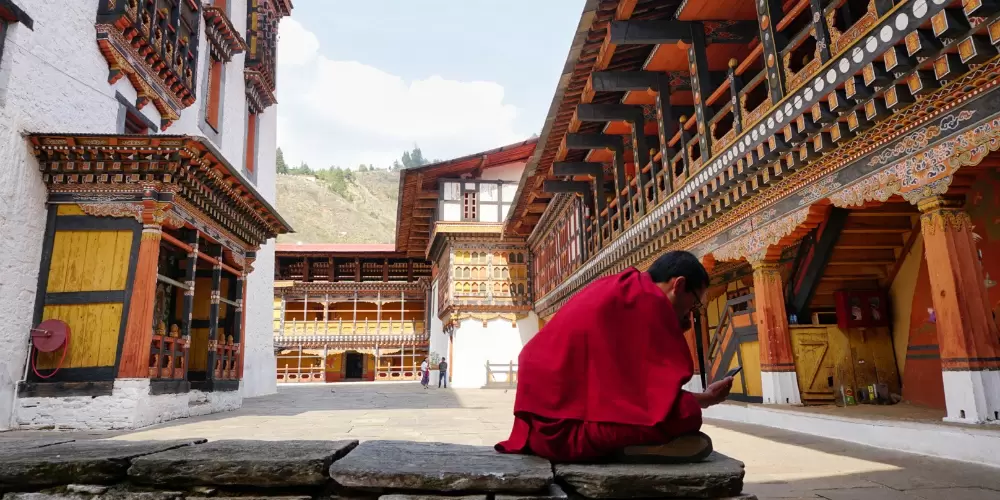
My guide Ugyen and driver Jamyang did much more than take me through Bhutan. Between mountain passes, monasteries and long stretches of road, they offered glimpses into their families, ambitions and everyday values. The logistics were flawless, but that is not what stayed with me. What stayed was the feeling that the journey was not being delivered as a product. I was being invited, temporarily and carefully, into a living country.
The longer I travelled through Bhutan, the more I reconsidered my own priorities. That is what makes the country so relevant to destination marketers. Bhutan does not begin by asking how many visitors it can attract. It begins with a more difficult question: what kind of tourism supports the country it wants to remain and become?
What is sustainable tourism in Bhutan?
Sustainable tourism in Bhutan is a policy-led approach that seeks to balance visitor value, cultural continuity, environmental protection and benefits for local communities. Its best-known principle, often expressed as “high value, low volume”, is not simply a premium marketing position. It is an attempt to make tourism serve the country’s wider development philosophy rather than allowing visitor growth to become a goal in itself.
That distinction matters. Many destinations communicate sustainability while continuing to measure success primarily through arrivals, overnight stays and expenditure. Bhutan has never been free of tensions or changing policy choices, but it has consistently treated tourism as a question of governance. Marketing, access, pricing, service quality and national values are parts of the same system.
Tourism as an extension of national values
During my stay in Bhutan, I spoke with Damcho Rinzin, now Director of the Department of Tourism, Bhutan. Our conversation made clear that tourism is not an end in itself, but an extension of Bhutan’s national values. In written follow-up answers, he described the country’s current ambition as regenerative tourism: tourism that goes beyond limiting harm and actively strengthens communities, culture and the natural environment

A destination that begins with national values
Bhutan’s tourism approach is closely connected to Gross National Happiness, the national development philosophy that places wellbeing alongside economic progress. It asks policymakers to consider social development, cultural continuity, environmental conservation and good governance together.
This does not mean that every person in Bhutan is happy, nor that the model is beyond criticism. The strategic value lies elsewhere: the country has created a recognisable framework against which development choices can be discussed. Tourism is expected to contribute to the wellbeing of residents as well as visitors.
During my earlier visit, I spoke with Damcho Rinzin about this relationship between tourism and national values. He is now Director of Bhutan’s Department of Tourism. In written follow-up answers, he described Bhutan’s current ambition as regenerative tourism: tourism that does not merely limit harm, but contributes to making the country stronger for present and future generations.
From recovery to regenerative tourism
The pandemic exposed how vulnerable tourism economies can become when international travel stops. According to Damcho, Bhutan used that disruption to reconsider the sector. The country invested in infrastructure, digital services, visitor amenities and a broader range of experiences in culture, nature, wellness and adventure. Domestic tourism also received more attention as part of a more resilient visitor economy.
The post-pandemic brand Bhutan Believe gave that transition a public language. The word “believe” is more than a campaign line. It is intended to connect tourism development with confidence in Bhutan’s own values, people and capacity to shape change on its own terms.
That ambition is now being developed through the Bhutan Integrated Tourism Master Plan 2025–2034. Its four pillars include collaboration between public, private and community actors, regenerative tourism, a better regional distribution of tourism benefits and positioning Bhutan as a year-round destination. This is a meaningful evolution. Limiting volume alone does not automatically make tourism sustainable. The deeper questions are where visitors go, who owns the offer, who benefits and what the visitor economy leaves behind.
How the Sustainable Development Fee works today
The Sustainable Development Fee, commonly known as the SDF, is the most visible instrument in Bhutan’s tourism model. International visitors currently pay USD 100 per adult per night, with different arrangements for visitors from India and reduced rates for children. The fee is paid as part of the visa process and enters the national exchequer.
Bhutan states that these public funds support national priorities including healthcare, education and training, infrastructure, environmental conservation, cultural preservation and initiatives that strengthen local economies. Damcho also frames the fee as a way to preserve the tranquillity and intimacy of the visitor experience.
The system has changed over time. Visitors are no longer required to book every element of their journey through a tour operator, although certified guides remain mandatory for travel beyond the border towns and accredited support is required for trekking. This flexibility matters. Bhutan is still managing access, but it is no longer using exactly the same travel model that shaped its earlier international reputation.
The SDF should therefore not be described merely as a price barrier. Its strategic meaning depends on transparency, public value and the relationship between the fee and the quality of the experience. A high charge without visible local benefit becomes exclusionary. A contribution that residents recognise in services, conservation and opportunity can form part of a reciprocal visitor economy.
Local communities are not a backdrop
In his follow-up answers, Damcho emphasised village homestays, ecotourism, cultural experiences and opportunities for young people and women. These forms of tourism can create more direct local value than a model in which visitors remain inside a narrow circuit of internationally oriented hotels and attractions.
Community-based tourism is not automatically fair, however. A homestay only contributes to local development when residents retain control over the experience, pricing and story. Cultural participation should not turn daily life into a performance staged solely for visitors. The strategic task is to create access without hollowing out what makes a place meaningful.
This is where Bhutan’s guides remain essential. Ugyen did not simply explain monuments or manage a schedule. He translated context. Through conversations about family, work and values, the country became more than an itinerary. A guide can connect the official story of a destination with the layered reality of the people who live there.
Personal hospitality as strategic infrastructure
Destination strategies often place infrastructure, branding and data in separate categories from hospitality. Bhutan shows why that division is artificial. The human interaction is part of the infrastructure of the experience.
Damcho’s answers repeatedly return to meaningful and immersive travel. Visitors are seeking culture, nature, spirituality, wellness and experiences beyond the most familiar routes. Meeting that demand requires more than adding new products. It requires trained guides, locally owned businesses, reliable digital information, safe access and enough time for genuine contact to emerge.
Bhutan is also adopting technology. The Department of Tourism introduced a central Tourism Services Portal and a mobile application that connect visitors with accredited providers and practical information. Damcho says the department is exploring AI too, while seeking to keep human connection at the centre of hospitality. That balance is worth watching. Technology can reduce friction and widen access to local businesses, but it should support the encounter rather than replace it.
Positioning begins with the courage to choose
Bhutan’s strongest marketing asset is not a logo, an index or a claim that everyone in the country is happy. It is the relative consistency between the country’s story and the choices behind it. Culture, nature, spirituality and restraint are not simply creative themes. They influence access, pricing, product development and the desired behaviour of visitors.
This creates a distinct position. Bhutan will not suit every traveller, and that is precisely the point. Strong positioning does not try to become attractive to everyone. It identifies the values a destination wants to protect, the visitors who can engage with those values and the conditions under which the encounter should take place.
For destination marketers, two lessons remain fundamental:
- Know what must not be lost. Positioning becomes credible when it grows from cultural identity, landscape and community priorities rather than from market fashion.
- Connect the promise to policy. A sustainability message has little value when pricing, access, investment and measurement continue to reward volume alone.
What other destinations can learn from Bhutan
Bhutan’s model cannot simply be copied. It is a small country with a specific political system, geography, history and development philosophy. Its approach also contains unresolved tensions: between exclusivity and accessibility, national revenue and local distribution, careful planning and individual freedom.
What can be transferred is the willingness to make choices. Sustainable tourism marketing begins before the campaign. It begins with deciding which visitor economy a destination wants, what residents should gain, what ecological and cultural limits must be respected and how success will be measured.
When Ugyen thanked me for visiting, he connected my presence to something larger than my own trip. That moment stayed with me because it made reciprocity tangible. A destination does not become sustainable by asking visitors to admire it. It becomes more sustainable when the relationship between guest and place creates value that people can recognise, share and carry forward.
Updated on 6 July 2026. This article was revised to reflect Bhutan’s current tourism policy, the USD 100 Sustainable Development Fee, the Department of Tourism’s Integrated Tourism Master Plan 2025–2034 and written follow-up answers from Damcho Rinzin, Director of the Department of Tourism, Bhutan.
Isabel Mosk is a tourism strategist and founder of Sherpa’s Stories. She has worked with more than 50 destinations worldwide and specialises in tourism trends, strategy, positioning and storytelling.