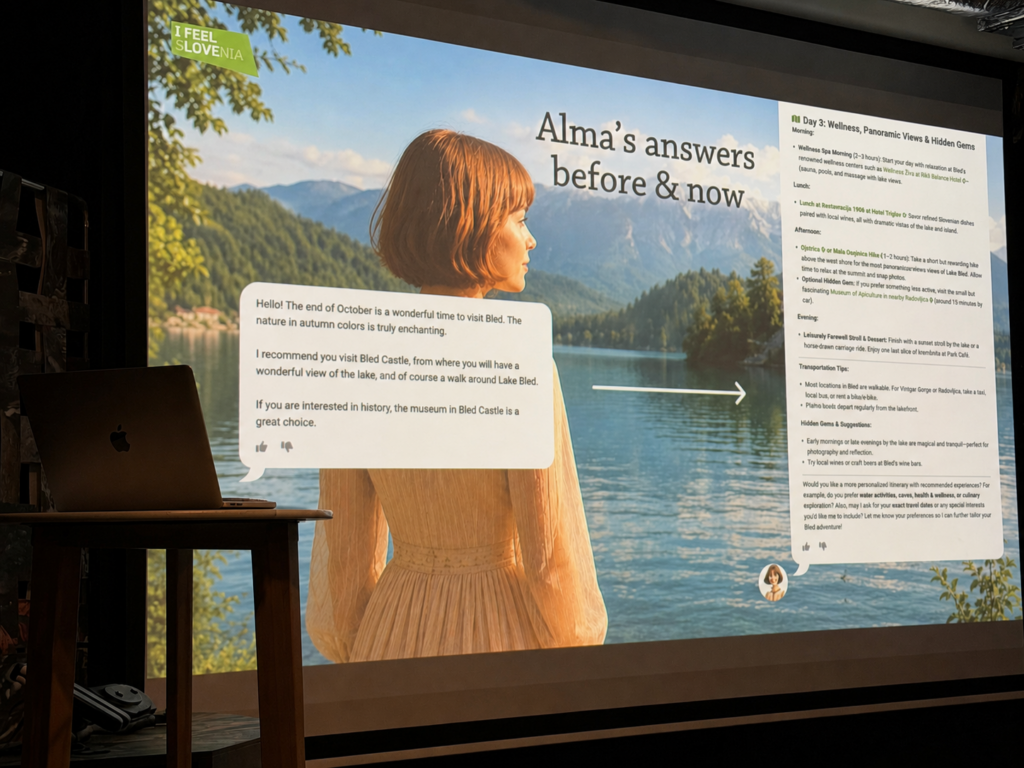

Smarter travel with AI: from prediction to immersion
By 2026, artificial intelligence will no longer be a thing of the future, but everyday practice in tourism and hospitality. The use of AI applications is growing rapidly worldwide, both among travelers and within the travel industry. Travelers expect greater convenience, customization, and speed, while companies are focusing on automation and data-driven optimization.
AI makes travel more personal, more efficient and, when used consciously, also more sustainable. At the same time, the rise of automation emphasises the importance of human input. In a world where algorithms serve the masses, context, background and imagination make all the difference.
Travel planning with a digital guide
Anyone who Googles “most beautiful beaches in Portugal” today will see it: no list of links, but an automatically generated summary at the top of the page. Google’s Search Generative Experience (SGE) provides direct answers based on AI. Fast, clear, and increasingly personalized. AI is no longer a static database, but a dynamic travel advisor.
Tools such as ChatGPT, Gemini, and travel apps like Kayak or Booking.com offer customization based on preferences, season, and previous choices. Within minutes, a complete itinerary can be generated, including accommodations, activities, travel time, warnings, and cultural etiquette. And this is just the beginning.
At the same time, it is important to remain critical. A Spanish influencer couple recently missed their flight to Puerto Rico because they received incorrect visa information from ChatGPT. AI thinks along with you, but it has its limits. Human verification remains important.
AI as an assistant for travelers: convenience with limits
Nowadays, anyone planning a trip rarely does so without digital help. Artificial intelligence has rapidly become a silent force behind many of the applications that travelers use. From booking platforms to route planners and price comparison sites, AI primarily adds speed and convenience. The technology helps filter the abundance of choices, adapts increasingly well to personal preferences, and is increasingly taking work off our hands.
For the individual traveler, this mainly means that preparation takes less time and causes less choice stress. Based on search behavior, previous bookings, or saved preferences, AI can put together an itinerary that matches personal interests. Where traditional travel apps are primarily functional, AI applications now add a layer of personalization. Think of suggestions for sights that match your profile, or restaurants that take dietary requirements into account.
Travel platforms such as Hopper use AI to predict flight prices and advise travelers when it is best to book. Google Flights also uses previous price trends to indicate whether a ticket is likely to increase or decrease in price. In this way, AI helps travelers make smart booking decisions, even though the market can sometimes be volatile and unpredictable.
AI also simplifies the booking process itself. Advanced chatbots can put together entire trips, from flights and accommodation to transportation and activities at the destination. For simple trips in particular, it is possible to put together a complete travel package in a matter of minutes, without human intervention.
The situation is different for more complex trips. A tour with multiple stops or a family trip with specific requirements may be presented quickly and clearly, but these plans are rarely flawless. Routes may be illogical, accommodations may not be available, or personal preferences may not be sufficiently taken into account. In this sense, AI is primarily a tool for quickly creating an overview. It still requires human assessment and adjustment.
It is striking that many travelers want to use AI, but do not yet fully trust it. Human control remains important, especially in sensitive areas such as visas, health, or regulations. AI does not take over travel, but it does make it clearer and more accessible. The benefits are in time, clarity, and simplicity, with room for conscious choices.
Sustainable travel thanks to smart technology
AI opens up new possibilities for making travel more sustainable without overwhelming travelers with complicated information. More and more applications are helping people make conscious choices, for example by showing CO₂ emissions or offering alternative routes.
Google Maps, for example, shows the most environmentally friendly route by default when it is comparable in travel time. Airlines such as Lufthansa are experimenting with so-called green fares, which make partial use of sustainable fuels.
AI also helps to spread tourist crowds. Apps notify travelers about overcrowded destinations and suggest quieter alternatives. This reduces pressure on popular places and encourages people to discover lesser-known areas.
On the policy side, AI is used for visitor management. VisitScotland, for example, uses data dashboards to direct tourist flows in vulnerable nature areas. In the future, these systems could become even smarter, for example by including weather forecasts, biodiversity, or seasonal peaks in the analysis.
At the same time, it is important to note that AI itself consumes energy. Training and running large models requires a lot of server capacity. AI is therefore no guarantee of sustainability, but it does offer opportunities to make sustainable alternatives more visible and accessible to travelers who want to make conscious choices.
Optimization behind the scenes
In addition to visible applications for travelers, AI also plays an important role behind the scenes. In the travel and hospitality sector, the technology is increasingly being used to streamline processes, reduce costs, and optimize revenues, often without the traveler noticing.
Operational processes, such as sending booking confirmations, processing refunds, or answering standard questions, are faster and more consistent thanks to AI. This leaves more room for personal contact where it really matters.
Pricing strategies are also being refined with the help of AI. Dynamic pricing models respond immediately to demand, competition, seasonality, and external factors such as weather or local events. Where this used to be done manually, it is now largely automated.
In aviation, AI is used for predictive maintenance. Airlines such as United Airlines and Air France-KLM analyze large amounts of data to identify when an aircraft part needs to be replaced in good time. This prevents malfunctions and increases operational efficiency.
The airport experience is also changing. Biometric technology such as facial recognition is being used at more and more airports for security and boarding. In the Netherlands and Belgium, this development is still in the testing phase, but in many Asian countries and the United States, it is now commonplace. The advantages are clear: faster throughput and improved security.
Customer service is also making use of AI. Chatbots and voicebots provide real-time updates on delays, changes, or alternatives. Platforms such as Priceline are even experimenting with voice-activated assistants based on advanced language models.
In the hotel industry, AI supports the planning of cleaning rounds, the optimization of energy consumption, and the coordination of staff deployment based on occupancy rates and guest behavior. This not only leads to more efficient operations, but also to a more sustainable and comfortable stay.
The enduring value of human expertise
Although AI is automating more and more parts of the travel process, human expertise remains indispensable. While technology delivers information at lightning speed, humans provide interpretation, depth, and experience. A digital assistant presents the most popular sights; a guide tells the story behind an inconspicuous alleyway or shares local customs that cannot be found anywhere else.
The power of human involvement lies precisely in empathy, imagination, and customization. This plays a role not only in the content, but also in tailoring the travel experience to the character of the traveler.
For travel professionals, the challenge is not to replace human advice, but to enhance it. AI offers structure, speed, and scale. People provide connection, meaning, and trust. That is precisely where the travel experience that lasts is created.
Isabel Mosk is a tourism strategist and founder of Sherpa’s Stories. She has worked for more than 50 destinations worldwide and specialises in tourism trends, strategy, positioning and storytelling.