AI as the New Governance Layer of the Destination
AI in tourism is often discussed through its most visible applications: chatbots, trip planners and smarter search. But the real shift goes deeper. There was a time when a destination mainly needed to be visible: a strong campaign, a good website, a recognizable slogan, imagery that stayed with people. The traveler dreamed, searched, clicked, read, compared and booked. Destination marketing had a familiar front end: brochures, websites, social media, campaigns, press trips and content.
But anyone who follows the sector knows that this story has already moved on. The DMO is no longer only a marketing organization. In recent years, the field has shifted toward destination management, and increasingly toward destination stewardship: managing visitor flows, liveability, value creation, carrying capacity, sustainability and the balance between visitors, residents and entrepreneurs.
After years of traveling through almost one hundred countries, I have become less and less convinced that a destination can ever be easily summarized. The places that stay with you are rarely the ones that fit neatly into a single slogan. They are full of contradictions: beauty and pressure, hospitality and dependency, desire and limits. That is why the rise of AI in tourism touches something larger than technology. If machines begin to summarize, plan and recommend destinations, we have to ask which parts of a place become visible, and which parts slowly disappear from view.
If we only see AI as a chatbot, we miss the real shift. AI does not simply add another tool to destination management. It creates a new governance layer around the destination: a layer in which data, content, entrepreneurs, travelers, platforms and public values become newly connected.
The question is no longer only: how do we attract visitors? It is not even only: how do we manage visitor flows better? The question becomes: how do we make sure our destination is understood by both people and machines, and that this understanding contributes to the future we want for the place?
Recent examples from Canada, Austria, Saudi Arabia, New Zealand and Slovenia show five emerging roles for DMOs and national tourism organizations.
The Destination as Knowledge Layer
Canada shows that AI begins with something less visible than a chatbot, but strategically much deeper: data. Through the Canadian Tourism Data Collective and applications such as Aurora AI, Destination Canada is building a shared knowledge layer for the sector. Not just reports, dashboards or separate market insights, but a system in which tourism data becomes easier to search, interpret and apply.
That may sound technical, but the meaning is significant. Whoever organizes the data also organizes the ability to make decisions. Where do visitors come from? Which segments are moving? Which regions have potential? Where is pressure emerging? Which signals from markets, behavior and sentiment deserve attention? A destination that structures its knowledge well becomes less dependent on intuition and campaign logic. It can make sharper choices around dispersal, value, product development and long-term positioning.
Research and data were, of course, already part of destination management. What is new is that AI makes this knowledge layer more active. Data does not only inform policy, but can become searchable, conversational and useful for entrepreneurs, policymakers and, eventually, travelers. The destination is not only measured. It is made readable.
The Destination as Ecosystem Builder
Austria takes a different route. With Change Tourism Austria, Austria Tourism positions itself not primarily as the builder of one central AI tool, but as a driver of sector-wide change. Think Digital Travel describes how the platform works with use cases, start-up spotlights, community building and hackathons to help tourism businesses understand and apply new technology, including AI.
That matters because AI adoption in tourism does not happen automatically. The sector is made up largely of small and medium-sized businesses. Hotels, guides, attractions, restaurants, regions and DMOs do not all have innovation teams, data specialists or AI strategists in-house. Often there is curiosity, but also uncertainty. What can I do with it? Where do I start? What is legally allowed? What fits my business? What might weaken my uniqueness?
The role of the DMO then becomes less about building everything for the sector, and more about creating the conditions in which the sector can learn, experiment and grow responsibly. That is ecosystem work. It is less visible than a campaign, but perhaps more valuable. A destination does not become AI-mature because one organization launches a tool. It becomes AI-mature when knowledge, skills, trust and experimentation begin to circulate through the entire network.
The Destination as Productivity Partner
Saudi Arabia shows a more direct and ambitious route. According to the Saudi Press Agency, the Ministry of Tourism launched an AI Tourism Vision to help shape the future of global tourism. The vision focuses not only on the visitor, but also on operational transformation, responsible innovation and ecosystem empowerment. In doing so, Saudi Arabia positions AI not as a separate digital application, but as strategic infrastructure for the development of the entire tourism sector.
This is a different category. Here AI is not only about inspiration or better information. It is about increasing the productive capacity of the sector. Especially in a destination that wants to scale quickly, with new hotels, new experiences, new entrepreneurs and a growing visitor flow, AI becomes a lever for quality, speed and professionalization.
At the same time, this role raises questions. When a government uses AI to help the sector work faster and more efficiently, the relationship between public support, market dynamics and entrepreneurship also shifts. Baseline quality may rise, but uniqueness can flatten if many actors begin to rely on the same systems, formats and standards. That is why the term productivity partner is more useful than productivity platform. The DMO or government does not have to become everything itself. But it can help entrepreneurs become stronger, faster and more professional, as long as local identity, creativity and entrepreneurship do not disappear into standardized output.
The Destination as Answer Layer
New Zealand perhaps shows most visibly how the front end of destination management is changing. On newzealand.com, an “Ask our AI” function is visible, where travelers can ask questions such as how long flights take, what the best things are to do in each season and how easy it is to travel around.
A long-haul destination always has thresholds. Flight time, budget, route choices, seasonality, transport and the basic question of whether the trip is worth the effort. In the past, a website had to solve those doubts through pages, menus and inspiration blocks. Now a destination can respond directly to the traveler’s uncertainty. That makes the DMO site less like a brochure and more like a conversation partner.
The strategic value is not only convenience. It is also agency. When travelers ask their questions to generic AI systems, a destination is summarized through fragments, old content, commercial platforms and incomplete sources. By building its own AI layer, a DMO can explain the destination from its own knowledge, current information and strategic choices.
New Zealand shows that AI discoverability is becoming a new layer on top of SEO. It is no longer only about being found in search engines, but about appearing well in answers, conversations and planners. The destination must not only be visible. It must be understandable to AI.
The Destination as Steward of Trust
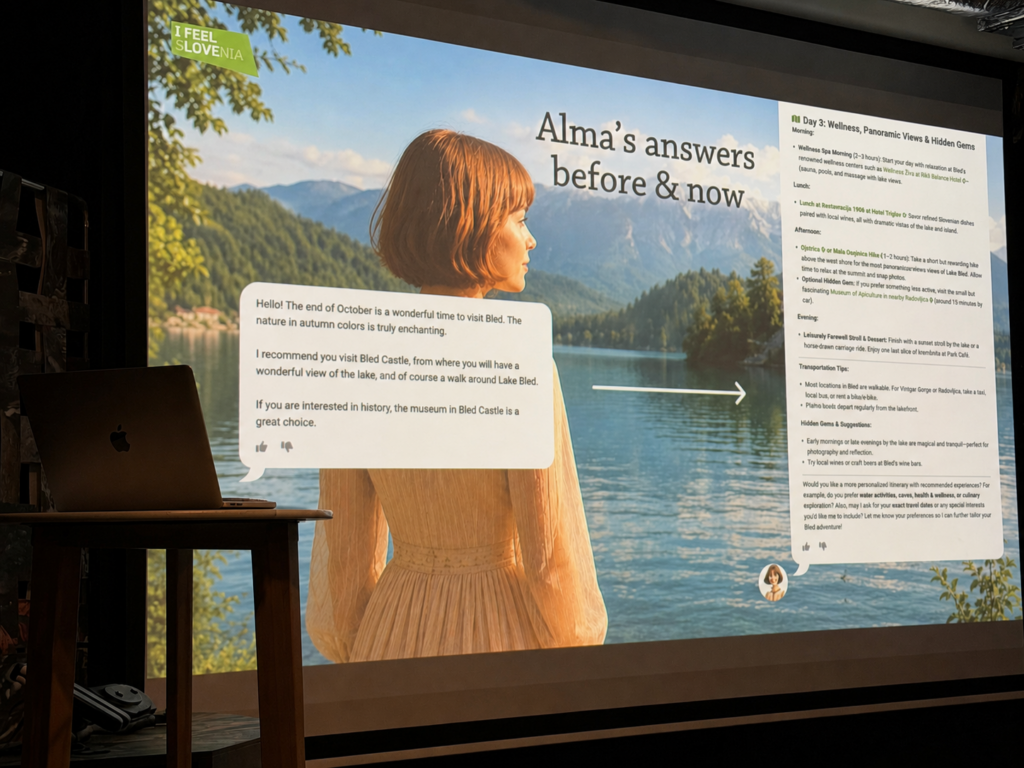
Slovenia is particularly strong as a public governance case. With Alma, the Slovenian Tourist Board shows not only how an official AI travel guide can work, but also how important transparency, responsibility and data use become once a destination starts giving answers itself.
Alma is AI, not a human being. Answers may be incomplete, outdated or wrong. Important information should be checked with official providers. The solution uses OpenAI technology. Chats are temporarily stored. Users are warned not to enter personal data. Privacy, responsibility and data processing are explicitly addressed.
That may sound legal or technical, but this is exactly where maturity in AI and tourism becomes visible. Once AI starts advising travelers, influence emerges. Which places are recommended? Which entrepreneurs become visible? Which regions remain out of sight? How are crowding, sustainability and accessibility taken into account? What happens if an AI agent gives outdated information? Who is responsible when a traveler is sent in the wrong direction?
The DMO of the future must therefore not only inspire, steer or accelerate. It must also safeguard. Not as a brake on innovation, but as a steward of trust, quality and public values. This is especially true in tourism, where a destination is never just a product. A destination is a living system of residents, entrepreneurs, nature, culture, infrastructure, stories and desires. AI can strengthen that system, but it can also simplify it. It can help disperse visitors, but also create new pressure. It can make small businesses more visible, but also amplify existing power structures.
The New Governance Layer
Together, these examples show that AI does not push the DMO back toward marketing. It adds a new layer to destination management. The DMO becomes a knowledge layer, as in Canada. An ecosystem builder, as in Austria. A productivity partner, as in Saudi Arabia. An answer layer, as in New Zealand. A steward of trust, as in Slovenia.
These are not separate technology projects. They are new forms of destination management in a time when machines help determine how places are found, understood, planned and recommended. The destination of the future competes not only for attention, but also for interpretation. Who explains the place? Who feeds the systems travelers use? Who determines which stories, routes, entrepreneurs and values become visible? Who ensures that AI is not only efficient, but also fair, current and rooted in the soul of the place?
Perhaps that is the real shift. Destination management was already about more than promotion. It was about steering, connecting, protecting and developing. AI does not make that task smaller. It makes it more complex. It forces destinations to organize their knowledge, content, responsibility and values in such a way that they can move within a world where travelers no longer only search, but ask questions to systems that answer.
A destination that is only beautifully visible will increasingly be summarized by machines. A destination that understands, structures and explains itself well can help shape how it appears in this new layer. And perhaps that is where the new task begins: not with the question of which AI tool a DMO should build, but with the question of what a destination wants to be understood.
Isabel Mosk is a tourism strategist and founder of Sherpa’s Stories. She has worked for more than 50 destinations worldwide and advises organisations on tourism trends, strategy, positioning and storytelling.