

AI in Destination Management: From experimentation to organisational transformation
AI in destination management is moving beyond individual tools and experiments. Destination management organisations now need to rethink their leadership, workflows, transparency, digital visibility and the role of their websites. This article explores how DMOs can use AI responsibly while protecting public trust, local knowledge and human value.
XDW 26, organised by the Digital Tourism Think Tank, demonstrated why it has become one of the leading events for destination management organisations exploring artificial intelligence. Together with Lili, I facilitated four lab sessions and joined conversations with DMOs about internal transformation, transparency, discoverability and practical experimentation. One conclusion stayed with me: AI is not simply another digital project for DMOs. It represents an organisational transformation and, increasingly, a question of public trust.
From individual tools to organisational change
Many destination management organisations are actively experimenting with AI. Teams are testing tools, running pilots and using AI to support research, writing, translation, design and other individual tasks. This experimentation is valuable because it helps employees develop practical skills and discover where AI can reduce friction. However, most efficiency gains are still taking place at task level, while the wider implications for workflows, roles, knowledge systems, governance and organisational culture remain largely unexplored.
Responsibility for AI is also frequently placed with a digital manager or a small group of enthusiastic employees. Yet a development that could affect the entire organisation cannot remain solely a digital responsibility. AI may enter an organisation through a tool, but its impact does not stop there. The strategic question is no longer simply which tools a DMO should use, but how the organisation should work differently now that these capabilities exist.
In my work as a tourism strategist with destinations around the world, I see interest in AI developing much faster than organisational readiness. Employees are already experimenting, sometimes using platforms outside their organisation’s approved environment. Digital teams are expected to provide answers, while management is still determining what AI means for strategy, governance and future roles. This creates a growing gap between what people can already achieve with AI and what their organisation is prepared to support responsibly.
At the same time, I see enormous potential. AI can reduce friction for travellers and organisations, while giving ambitious destinations with limited resources access to capabilities that were previously beyond their reach. Digital products and campaigns that once required months and significant investment can sometimes now be developed in days. However, greater production speed does not automatically lead to better tourism. The real value of AI depends on whether it supports the destination’s strategy, enables more thoughtful choices and strengthens its relationship with visitors.
AI can also help destinations manage visitor flows more intelligently. By combining information about demand, capacity, seasonality and weather, destinations may be able to guide visitors towards different places and times. Used thoughtfully, this could support a more balanced distribution of tourism. At the same time, AI should not automatically be presented as a sustainable solution, as its own energy use and environmental impact must also be considered.
AI readiness starts with leadership and learning
AI readiness is about much more than access to technology. It is the ability of an organisation to use artificial intelligence purposefully and responsibly across its people, processes, knowledge, technology and governance. This requires clear ownership at management level, opportunities for employees to develop practical experience and understandable boundaries within which experimentation can take place. It also requires organisations to reconsider complete workflows instead of simply adding AI to individual tasks.
As Theresa Kan from the Austrian National Tourist Office said during XDW 26, know-how and enablement are the real bottlenecks. Austria’s use of smaller internal communities offers an interesting approach. By creating spaces where colleagues can exchange knowledge, discuss experiments and learn from one another, AI capability becomes something that develops throughout the organisation rather than remaining concentrated in one team.
The Aruba case also stood out because its AI strategy was being addressed at management level. Visible leadership turns AI from an isolated digital initiative into an organisational priority. Leaders do not need to understand every tool in detail, but they do need to understand the implications for strategy, people, investment, accountability and the organisation’s relationship with visitors.
The organisations that lead this development will treat AI as a strategic question rather than a technology question. Those that simply add AI to existing workflows risk falling behind organisations willing to rethink their processes, knowledge infrastructure and relationship with travellers. An AI strategy without organisational change may remain little more than a document, while experimentation without governance will remain fragmented. DMOs need both.
Transparency as part of public trust
One of our lab sessions examined the AI Transparency Framework developed by the Digital Tourism Think Tank. The framework provides practical models that organisations can use to communicate what AI contributed, how much time it saved, its environmental impact and whether AI-supported content was produced responsibly.
This is particularly relevant for DMOs because many are public or quasi-public organisations. They are accountable to visitors, residents, partners, governments and funding bodies. When AI contributes to a campaign, strategy, report, image or social media post, should that involvement be disclosed? How should the balance between human and AI contributions be assessed? What happens when commissioned suppliers use AI without communicating it?
Transparency is not simply about adding an AI label. It concerns authorship, accountability, environmental responsibility and editorial integrity. It also affects procurement. When AI materially changes the time or resources required to produce work, existing assumptions about effort, value and pricing may need to be reconsidered.
In my view, DMOs should not wait until every policy question has been answered. They can begin developing transparent practices now. When AI use remains invisible, it becomes more difficult to protect public trust, evaluate suppliers and have honest conversations about productivity and value. Taking the lead on transparency can demonstrate that innovation and responsibility do not have to be opposing forces.
Visibility, SEO, GEO and the DMO website
AI is also transforming how travellers discover, evaluate and select destinations. Travellers increasingly use AI assistants, conversational search and AI-generated overviews to create their shortlists. A destination may therefore be considered or excluded before someone ever reaches its official website.
This creates a particular risk for smaller destinations and tourism businesses. When their information is outdated, fragmented or difficult for machines to interpret, AI platforms may rely on commercial intermediaries or better-structured competitors. Search Engine Optimisation therefore remains essential, but it is no longer sufficient on its own. SEO helps travellers find a website, while Generative Engine Optimisation helps AI systems find, understand and accurately represent a destination. DMOs need a strategy for both.
Effective SEO and GEO require more than optimised website copy. They depend on current, structured and consistent information across websites, listings, reviews, social channels and other credible digital sources. DMOs should not only ask whether their website ranks in traditional search results. They must also understand whether AI platforms recognise what makes their destination distinctive, whether they use reliable sources and whether they represent the destination accurately.
Visibility should not become the only measure of value, however. Some of the most meaningful travel experiences have little or no digital footprint. During my travels through Central Asia, several of the best guesthouses could only be contacted through WhatsApp. AI would never have found them, yet they became highlights of the journey. This creates an important new responsibility for DMOs: helping local businesses, stories and less-visible experiences remain discoverable without reducing the richness of a destination to what an algorithm can easily process.
AI-generated answers also challenge the traditional role of the DMO website. If travellers receive practical information directly from an AI assistant, why would they still visit an official destination platform? One possible role is that of an open knowledge infrastructure providing reliable, current and machine-readable information to search engines, AI systems and other platforms. At the same time, the website could become a curated authority that offers trusted recommendations, local stories and expert choices that cannot easily be replicated elsewhere.
The DMO website could also develop into an intelligent service platform where visitors create, save and adapt personalised itineraries. Registration or membership might provide access to deeper personalisation, specialist knowledge, planning tools or community experiences. I would frame this less as placing content behind a membership wall and more as creating a meaningful value exchange. Visitors establish a direct relationship with the destination and receive genuinely useful services in return.
The strongest future model may combine these roles. Essential destination information should remain open, current and accessible for SEO and GEO, while personalisation, local expertise and planning services give visitors a reason to engage directly. Making everything freely available could turn the DMO into an invisible content supplier, but placing too much behind a membership wall could damage discoverability. A hybrid model offers a better balance: open where reach and reliability matter, and curated where human expertise creates additional value.
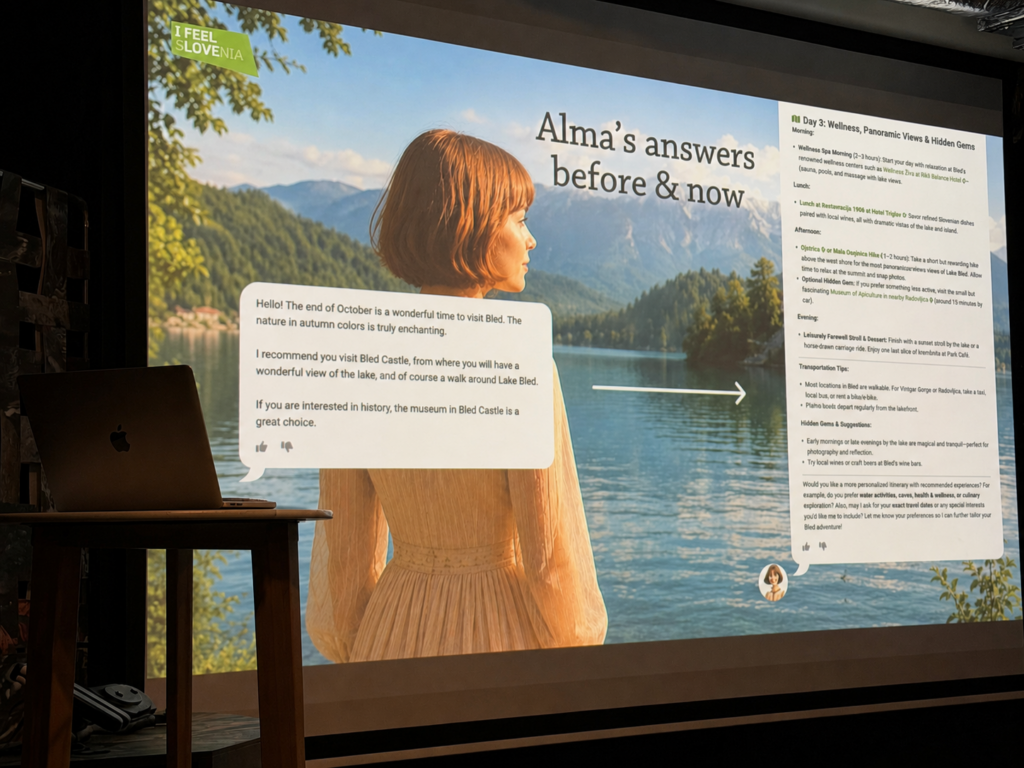
Tourism Slovenia’s Chat Alma offers an interesting glimpse of this future. Alma is more than a conventional chatbot. She is designed as a digital persona that helps visitors explore Slovenia through relevant information and recommendations. This leads to an important strategic question: if AI increasingly answers travellers’ practical questions, what unique value will make them visit, trust and return to a DMO website?
Vibe coding and changing expectations
Vibe coding was the most playful part of XDW 26 for me, but it also demonstrated how quickly expectations are changing. During a 30-minute lab, I showed how five websites could be created using Lovable, Base44, Codex and Google Gemini. One of them was a new landing page for Sounds Like Slovenia.
My aim was not simply to demonstrate how quickly websites can now be produced. I wanted to make the organisational consequences visible. When production becomes dramatically faster, value shifts from execution alone towards asking the right questions, providing direction, evaluating quality and applying human judgement. The required skills are changing, as are expectations about budgets, timelines and what teams can create themselves.
Access to AI tools remains uneven. Some DMO teams can only use approved platforms such as Copilot, while employees may privately experiment with a much wider range of tools. Prohibiting those tools will not stop this development, but uncritical experimentation creates risks involving privacy, accuracy, security, intellectual property and transparency.
A useful AI policy should therefore do more than provide a list of prohibited tools. It should help employees understand which tools and data they may use, when human review is required, when AI involvement should be disclosed and where experimentation is encouraged. Good governance should make learning safer and more purposeful, rather than simply making it more difficult.
The choices ahead
The next phase of AI adoption will not be defined by how many tools an organisation uses, but by the quality of the choices it makes. DMOs need to understand where AI is already being used across their organisation and supply chain, whether leadership is sufficiently involved and which workflows need to be redesigned. They must assess whether their destination information is reliable and structured enough for GEO, whether AI platforms represent the destination accurately and whether the organisation is sufficiently transparent about AI-supported work.
They must also decide what should remain distinctly and intentionally human. AI provides speed, structure and scale, while people provide context, imagination, empathy and meaning. A digital assistant can identify popular attractions, but local experts reveal the stories, customs and less-visible places that make a destination distinctive.
The role of the DMO is therefore not becoming less relevant. It is changing. The organisations leading this transformation will not necessarily be those using the most AI. They will be those that redesign their workflows, strengthen their knowledge infrastructure, protect public trust and understand where human judgement remains essential.
Isabel Mosk is a tourism strategist and founder of Sherpa’s Stories. She has worked for more than 50 destinations worldwide and advises organisations on tourism trends, strategy, positioning and storytelling.
Frequently asked questions
-
AI readiness is the ability of a destination management organisation to use artificial intelligence purposefully and responsibly. It includes leadership, employee skills, workflows, data and knowledge systems, technology, governance and meaningful human oversight.
-
Search Engine Optimisation helps content become visible in traditional search results. Generative Engine Optimisation helps AI systems find, understand and accurately represent information in generated answers. Both depend on useful, authoritative, accessible and well-structured content.
-
AI is more likely to change the role of the DMO website than make it irrelevant. The website can become a reliable knowledge infrastructure for search engines and AI systems while also offering curated expertise, personalisation and services that encourage direct visitor engagement.
-
Many DMOs operate with public funding or public responsibilities. Communicating how AI contributes to content, services and decision-making can support accountability, integrity and public trust.
-
A practical AI policy should explain which tools may be used, what data employees can share, when human review is required, when AI involvement should be disclosed and how teams can experiment responsibly.
Disclosure: This article is based on my own experiences, ideas and reflections, with AI used to edit, structure and sharpen the writing.