From Business Trip to Experience: Hybrid Hospitality as the New Standard
What began as adding a few leisure days to a conference or taking a laptop on holiday has become a fundamental redefinition of business travel. In 2026, work, accommodation and leisure are no longer separate domains. They come together in an integrated travel experience centred on autonomy, wellbeing and personal value. This development is increasingly described as hybrid hospitality.
From bleisure to a conscious choice
Bleisure, the combination of business and leisure, may once have been an improvised extension of a work trip, but it has now become a deliberate strategy. Travellers combine work and leisure not only for practical reasons, but because they are seeking balance and meaning. According to Hilton’s 2026 Trends Report, more travellers are choosing a so-called Whycation: a journey that begins with a personal intention rather than an agenda alone.
This need for autonomy and meaning extends to the MICE sector. People attending conferences or business meetings expect more than a tightly organised programme. They want time for recovery, inspiration and personal depth. Events therefore become part of a broader, more personal travel experience.
Hybrid hospitality as a foundation
Hybrid hospitality brings work, accommodation and leisure together within one integrated offer. Hotels may combine comfortable rooms with fully equipped workspaces, quiet zones, wellness facilities and digital services. Airlines and event venues are moving in the same direction, offering flexible stays and personal services that adapt to the traveller’s rhythm.
The business traveller of 2026 deliberately chooses destinations where work and wellbeing go hand in hand. This is not about briefly checking an inbox between activities, but genuinely integrating work into a broader stay. It calls for a new form of hospitality that is less functional and more holistic.
A workation without the rush
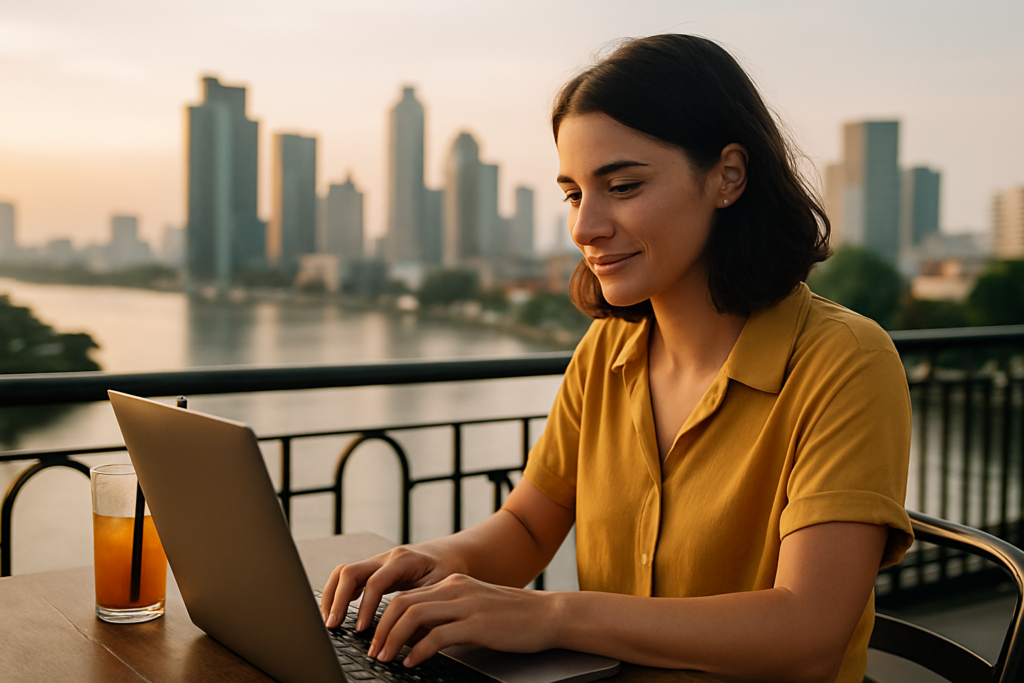
The workation is evolving too. The first generation of digital nomads moved from one hotspot to another, while today’s traveller increasingly seeks calm, stability and depth. The aim is no longer to travel as much as possible with a laptop, but to work purposefully in an environment that supports both focus and recovery.
Countries including Portugal, Estonia, Mexico and Japan are responding with dedicated visas for remote professionals and work-friendly infrastructure. At the same time, more retreats, coliving concepts and long-stay options are emerging in which work, lifestyle and local experience come together.
For providers, reliable Wi-Fi alone is no longer enough. The entire environment needs to work: space, quiet, good coffee, healthy food, inspiration and flexibility.
MICE is moving with the change
This hybrid approach is also influencing how business events are organised. In 2026, programmes are increasingly modular, allowing participants to decide how, when and at what intensity they take part. Networking happens during a walk or yoga session just as naturally as it does in a breakout room.
Destinations such as Singapore, Lisbon and Buenos Aires are positioning themselves as hybrid event destinations. They combine high-quality conference infrastructure with culture, wellness, gastronomy and strong digital facilities. The location is no longer merely a backdrop, but an extension of the overall experience.
Sustainable, digital and personal
The substance of business travel is changing at the same time. Companies increasingly value sustainability, technological integration and tailored experiences. Environmentally conscious destinations are prioritised when MICE venues are booked. Hybrid event formats, partly physical and partly digital, can extend reach while reducing travel movements.
Technology plays a connecting role. Personalised apps, augmented and virtual reality applications, and platforms for real-time interaction can deepen the event experience. Events are no longer organised only around programmes, but around the experience as a whole.
Incentive travel and meetings are therefore moving away from standard packages towards distinctive experiences. These might include culinary journeys, wellness programmes or cultural immersion, always tailored to participants’ values and preferences.
More than work or leisure
At the heart of hybrid hospitality is a different view of mobility. Travel is no longer simply a functional movement from one place to another, but a way of living and working at the same time. Moments of work, rest and encounter flow into one another.
This requires a different approach. It is becoming a new standard. Those who understand and facilitate the change will create not only better journeys and events, but stronger relationships with travellers who are making increasingly conscious choices.
Isabel Mosk is a tourism strategist and founder of Sherpa’s Stories. She has worked for more than 50 destinations worldwide and advises organisations on tourism trends, strategy, positioning and storytelling.